Hi all. In this post I’d like to document a little niche problem that’s widely known by index fund managers in Indonesia, and it’s related to the rebalancing date of an index fund.
I will assume that you’re already familiar with the concept of stock market index and index fund.
Index providers such as IDX would usually post something like this when there’s about to be a change in the index constituents:
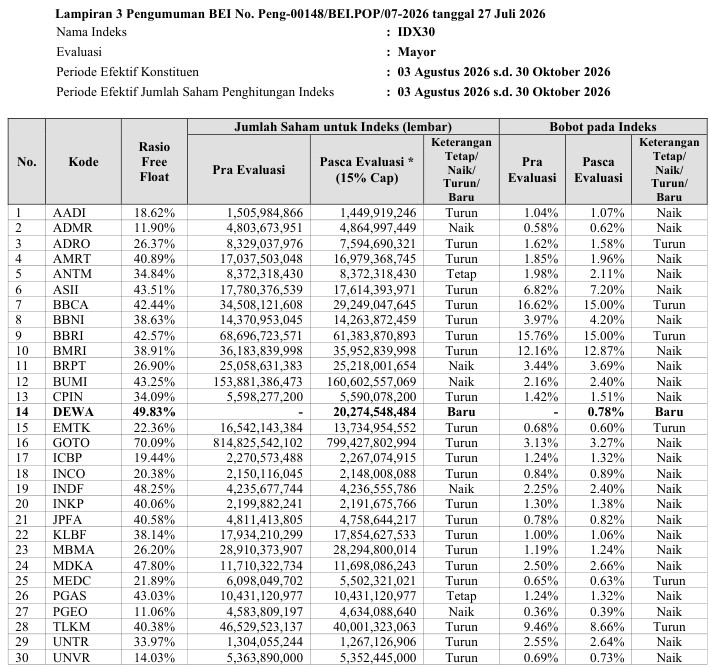
On the above table we can see the “effective period” of the IDX30 Index constituents; in this case, it’s from 3 August 2026 until 30 October 2026.
Suppose you’re a fund manager for an IDX30 Index Fund. My question is this: if you want your fund return to closely mimic the index, when should you rebalance the fund to reflect the new constituents and weightings?
If you answered 3 August 2026 (the start of the effective period), then you’d be wrong. The correct answer should be 31 July 2026, which is one trading day before 3 August 2026 (1 & 2 August 2026 were week-ends). More specifically, it should be done on market close on 31 July.
We can prove this empirically by trying to reverse-engineer the index return calculation. Below I have copied the important data for this exercise:
| Stock | Price (31 Jul’26) | Price (3 Aug’26) | Index Num. of Shares (Old) | Index Num. of Shares (New) |
|---|---|---|---|---|
| AADI | 9225 | 9100 | 1,505,984,866 | 1,449,919,246 |
| ADMR | 1515 | 1500 | 4,803,673,951 | 4,864,997,449 |
| ADRO | 2460 | 2470 | 8,329,037,976 | 7,594,690,321 |
| AMRT | 1325 | 1325 | 17,037,503,048 | 16,979,368,745 |
| ANTM | 2880 | 2870 | 8,372,318,430 | 8,372,318,430 |
| ASII | 5100 | 5050 | 17,780,376,539 | 17,614,393,971 |
| BBCA | 6325 | 6300 | 34,508,121,608 | 29,249,047,645 |
| BBNI | 3530 | 3520 | 14,370,953,045 | 14,263,872,459 |
| BBRI | 3040 | 3020 | 68,696,723,571 | 61,383,870,893 |
| BMRI | 4190 | 4170 | 36,183,839,998 | 35,952,839,998 |
| BRPT | 1845 | 1820 | 25,058,631,383 | 25,218,001,654 |
| BUMI | 165 | 168 | 153,881,386,473 | 160,602,557,069 |
| CPIN | 3290 | 3160 | 5,598,277,200 | 5,590,078,200 |
| DEWA | 460 | 464 | - | 20,274,548,484 |
| EMTK | 530 | 520 | 16,542,143,384 | 13,734,954,552 |
| GOTO | 50 | 50 | 814,825,542,102 | 799,427,802,994 |
| ICBP | 6975 | 7200 | 2,270,573,488 | 2,267,074,915 |
| INCO | 5275 | 5200 | 2,150,116,045 | 2,148,008,088 |
| INDF | 6975 | 7075 | 4,235,677,744 | 4,236,555,786 |
| INKP | 8400 | 8475 | 2,199,882,241 | 2,191,675,766 |
| JPFA | 2150 | 2180 | 4,811,413,805 | 4,758,644,217 |
| KLBF | 725 | 725 | 17,934,210,299 | 17,854,627,533 |
| MBMA | 505 | 515 | 28,910,373,907 | 28,294,800,014 |
| MDKA | 2720 | 2720 | 11,710,322,734 | 11,698,086,243 |
| MEDC | 1285 | 1305 | 6,098,049,702 | 5,502,321,021 |
| PGAS | 1500 | 1510 | 10,431,120,977 | 10,431,120,977 |
| PGEO | 1010 | 1005 | 4,583,809,197 | 4,634,088,640 |
| PTBA | 2320 | 2320 | 3,774,167,970 | - |
| TLKM | 2630 | 2740 | 46,529,523,137 | 40,001,323,063 |
| UNTR | 23950 | 23800 | 1,304,055,244 | 1,267,126,906 |
| UNVR | 1755 | 1740 | 5,363,890,000 | 5,352,445,000 |
Below is the IDX30 index level (from Investing.com):
- 31 July 2026: 349.77
- 3 August 2026: 350.00
The index return should be 350.00 / 349.77 - 1 = 0.066%.
Now we can test the hypothesis:
- H1: If the rebalancing is done on 3 August, then the index return on 3 August should reflect the old constituents
- H2: If the rebalancing is done on 31 July, then the index return on 3 August should reflect the new constituents
To test H1, we can calculate the index return as follows:
\[R_{H1} = \frac{\sum_i S_{i,\text{old}} P_{i,\text{3 August}}}{\sum_i S_{i,\text{old}} P_{i,\text{31 July}}} - 1\]where $S$ is the index number of shares and $P$ is the stock price; subscript $i$ indicates the individual stock.
To test H2, we use this formula:
\[R_{H2} = \frac{\sum_i S_{i,\text{new}} P_{i,\text{3 August}}}{\sum_i S_{i,\text{new}} P_{i,\text{31 July}}} - 1\]Below is the result:
- $R_{H1}$: 0.085%
- $R_{H2}$: 0.065%
As you can see, $R_{H2}$ is much closer to the actual index return of 0.066%. The difference of 0.001% can be attributed to rounding error (related to how the index level itself is calculated).
Therefore, if we want our fund to closely mimic the index return, then we should rebalance one trading day before the start of the new effective period.
Now this may sound like a trivial problem to you, but the real problem is that the capital market regulator doesn’t seem to recognize this fact. If you rebalance before the start of the effective period, your fund would be marked as breaching a rule.
Anyway, that’s it for this post. I hope you learn something new today.